


Free capacity.
Please RESERVE your seats in advance.
Warning About Fraudulent WhatsApp Messages
Fraudulent WhatsApp messages regarding hotel reservations are currently circulating. These messages ask guests to enter personal information or credit card details via a link. We would therefore like to remind you that messages from our resort are sent exclusively from official email email addresses. We never request credit card information via a link in a WhatsApp message.
Please do not click on such a link or enter any information. Ignore and delete the message, then block and report the number in WhatsApp. Your reservation with us remains valid in any case. If you have any questions, you can reach us at +43 2172 20 500 700 or by email at anfragen@stmartins.at.
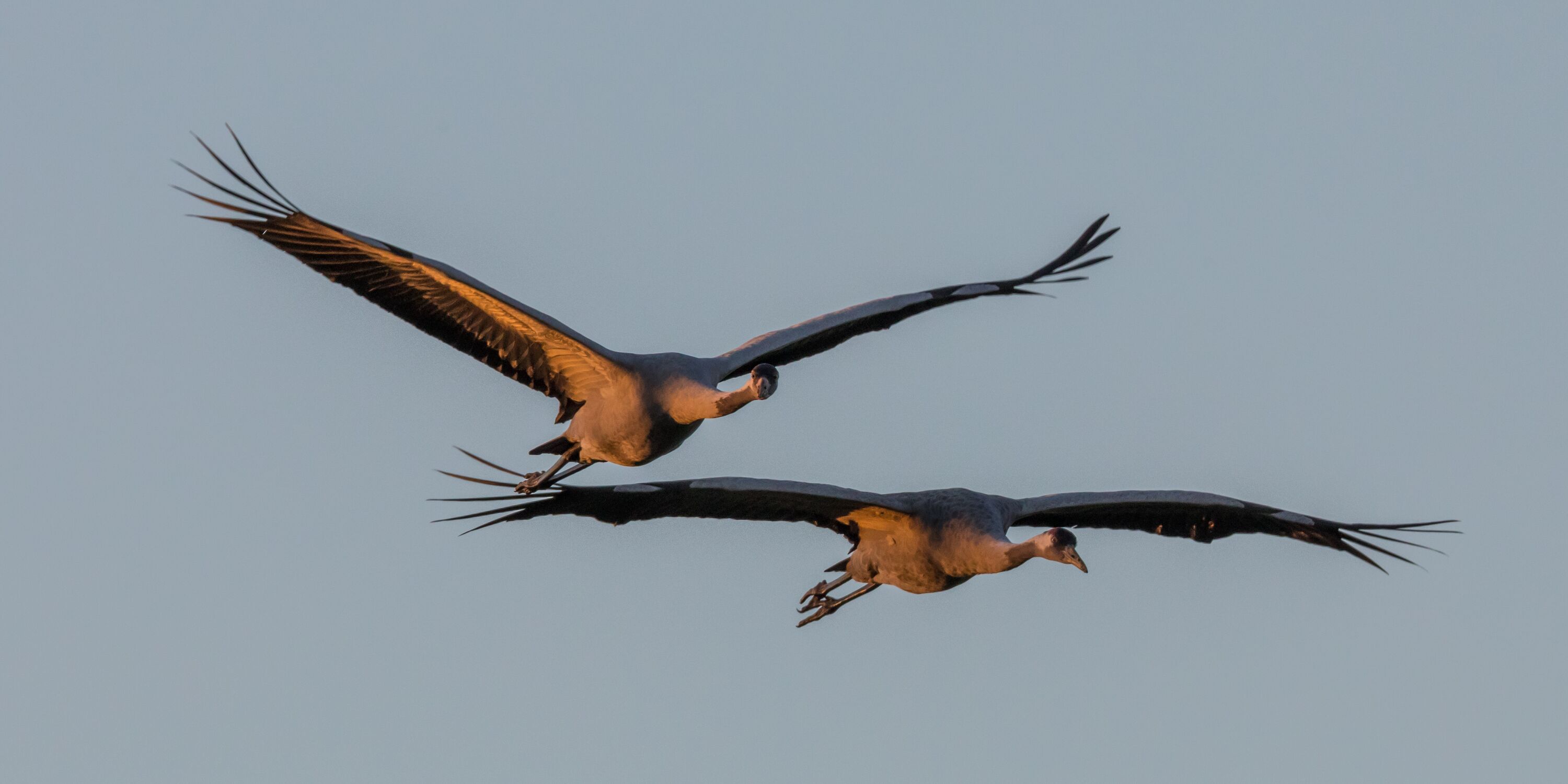
It’s me, the crane. Maybe you’ve seen me before. Or maybe not, since I’m usually only visible during the fall migration at the Seewinkel . I’m an imposing, long-legged, long-necked bird that feeds on both animal and plant matter.
I breed very rarely in Central Europe—or only in small numbers—and mainly in Northeastern Europe and Russia. That’s why, here in this country, I can usually be reliably observed only during migration seasons. In Austria, the Seewinkel is by far the most important migration and resting area for me, so the chances of spotting me on a fall safari are particularly high. I’m often seen in large open areas (meadows and fields) foraging or flying overhead, making a lot of noise.
Well, enough talk! The St. Martins Outdoor Team has put together a lot of interesting facts about me in a concise format. Enjoy reading!
See you soon!
Your Crane
Header image: Andreas Weith, via Wikimedia Commons
Article image: Andreas Trepte
Featured image: Bautsch, via Wikimedia Commons
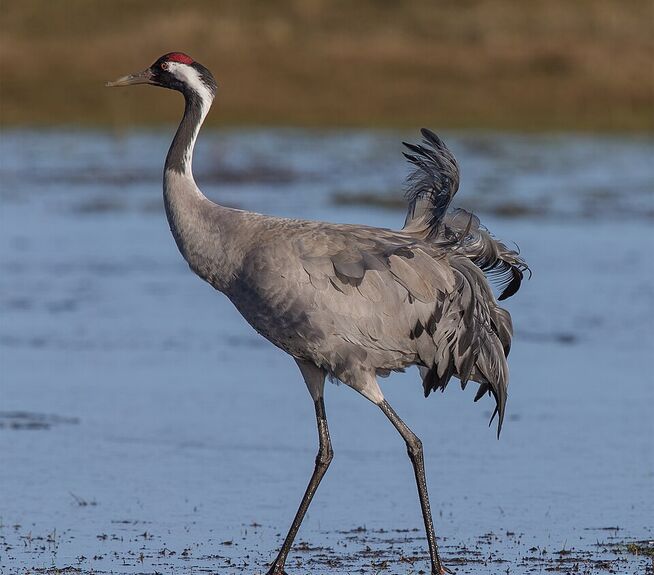
The crane is a bird about the size of a stork, predominantly gray in appearance, with long legs and a long neck. A striking feature is the black-and-white pattern on its head and neck, as well as the red patch on the head of adult individuals. Its sturdy, wedge-shaped beak is over ten centimeters long.
The pronounced feather train is also characteristic of this species in adult birds. Juveniles are generally somewhat browner in color, with a reddish-sand-colored head lacking conspicuous black-and-white markings; their feather train is not yet pronounced.
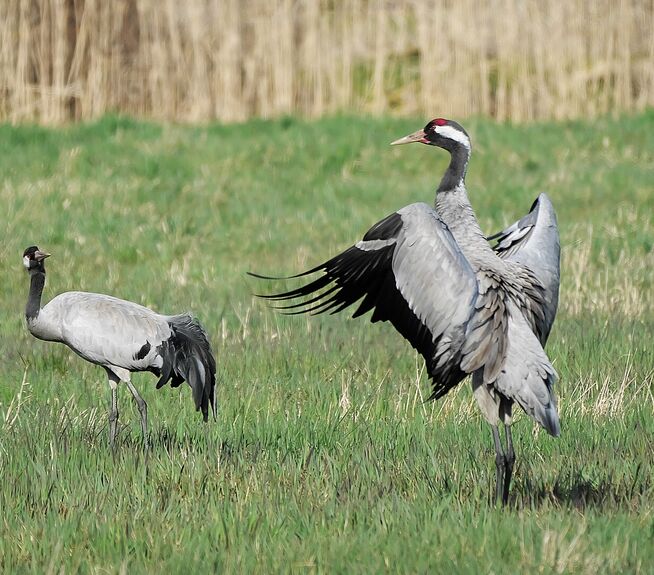
Cranes perform a very impressive courtship ritual—the so-called crane dance. During this ritual, males and females run around with their wings spread wide, letting out loud trumpeting calls. Egg-laying usually takes place in March or April, and they breed only once a year. Cranes are typically monogamous for life, though it is not uncommon for them to change partners.
The nest is built on the ground in damp or marshy terrain. The nest can be over one meter in diameter; the platform is usually 10 to 20 cm above the water’s surface and typically contains two eggs. The incubation period lasts between 28 and 30 days. The chicks are precocial and fledge after 65–70 days.
During the summer months, their diet generally consists mainly of animal matter, such as small mammals, reptiles, amphibians, worms, and insects. During the winter months, however, cranes feed primarily on plants, including various seeds (corn, barley, wheat, etc.).
The crane’s characteristic, loud, trumpet-like call earned it the onomatopoeic scientific name “Grus grus.” Cranes are known for calling frequently, and most of the time, you become aware of cranes flying overhead by their calls before you actually spot them.
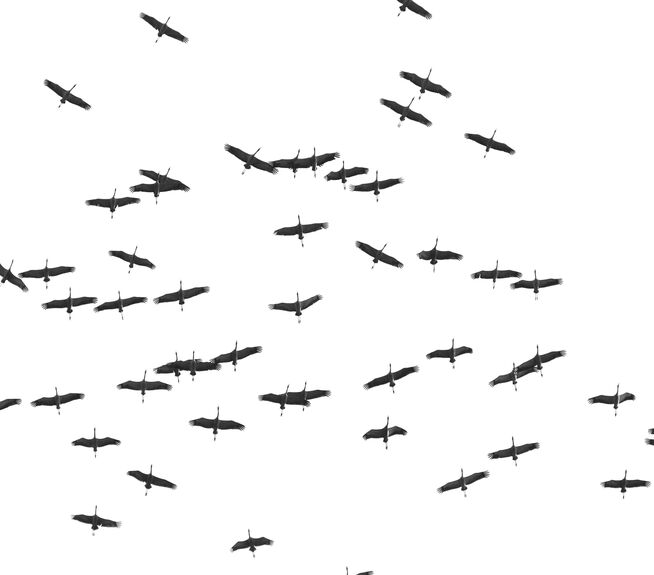
Image credit: Gllawm, via Wikimedia Commons
The crane’s most important breeding areas are located in northeastern Europe and northern Asia. In Central Europe, the species breeds in Poland, the Czech Republic, Germany, and, more recently, once again in Austria with a very small population. The species was once widespread as a breeding bird in Central Europe as well, but disappeared from many areas as a breeding bird starting in the late 19th century due to habitat destruction—primarily the cultivation and drainage of wetlands.
In Austria, the crane is currently one of the rarest breeding birds and is critically endangered. At present, isolated breeding pairs in Austria are found only in the northern Waldviertel region. The most important wintering grounds for cranes are located in southwestern Europe, North Africa, and the Middle East. However, a significant number now also winter in Central Europe, for example, in Germany.
The global population of the common crane is not currently threatened, and the European population is currently on the rise. In Central Europe, however, it is extremely rare as a breeding bird; the main reasons for this are the large-scale drainage of wetlands. Austria has been repopulated in recent years by fewer than 5 breeding pairs.
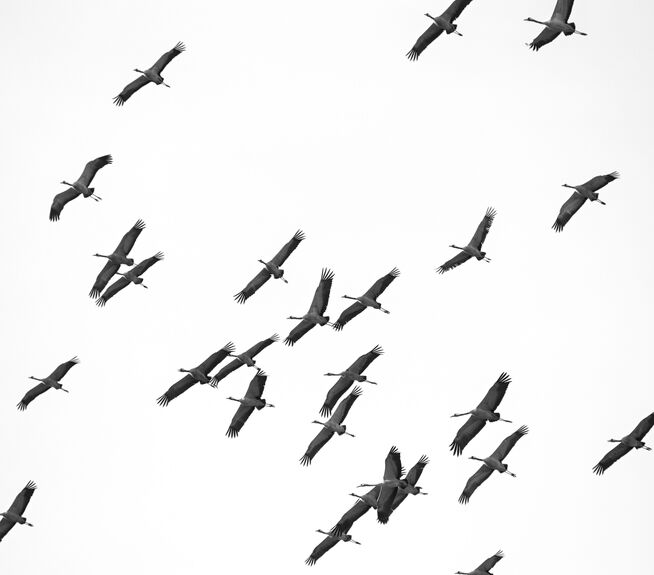
Image credit: Gllawm via Wikimedia Commons
When and Where?
The best conditions for observing cranes are in the fall at the Seewinkel , when they pass through and rest in the Seewinkel .
In October and November, it’s always worth taking a closer look at large fields or meadows to spot flocks of cranes foraging for food. It can also be worthwhile to glance up at the open sky every now and then to spot cranes flying overhead—though, given how vocal they are, they’re unlikely to go unnoticed.
Safari
Your best chance to spot cranes is on an autumn crane tour or a birdwatching safari in October and November. In addition to cranes, one of our knowledgeable St. Martin’s Rangers will show you other bird species that are easy to spot in the fall. After all, the Seewinkel is an ideal migration and resting area not just for cranes.
Listen to a crane's call
Watch the video of the crane
The top searches of the last 30 days


The Discovery
of Adventure & Retreat
Enjoy the retreat from everyday life in a luxurious way - with a Great Discovery Tour and 50 min. feel-good time at Treatments by St. Martins. Discover yourself anew!

Relax! Day vacation - THE ORIGINAL
Enjoy a day out in the thermal spa business class under the motto "Relax!". Experience a spa stay in a class of its own with exclusive Relax! services. Your short vacation with a long-term effect is waiting for you!

Beyond Everyday Life Beauty & Safari
Leisure & wonder. Freedom & comfort. For a whole week. Experience the unique connection between healing thermal water and a tasteful lodge, nature experience and relaxation. Renew yourself!


